AI is Cutting Jobs, Curing Diseases & Lying in Court
· Chirag Gadhvi
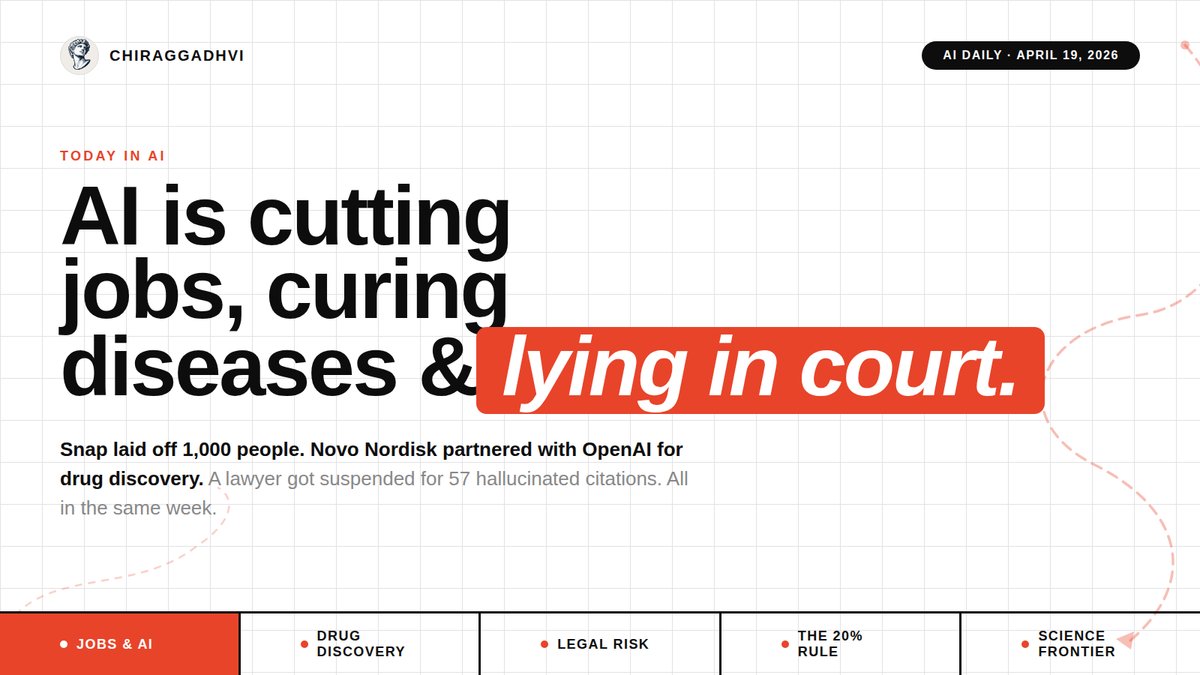
This week had something for everyone who thinks about what AI is actually doing to the world. Not the hype. The real stuff.
Layoffs. Drug breakthroughs. A lawyer who probably wishes he'd proofread. And a quietly alarming study that explains why most companies feel like they're losing the AI race even though they're using AI.
Let's go.
1. Snap Fired 1,000 People Because AI Writes Their Code Now
Snap announced the layoff of approximately 1,000 employees — about a quarter of its planned headcount — with CEO Evan Spiegel explicitly citing AI as the reason. Not restructuring. Not a market downturn. AI.
The number that tells the real story: AI now generates more than 65% of Snap's new code. That's not a pilot. That's production. The company expects to save over $500 million a year from this restructuring. Snap's stock jumped 11% on the news.
This is the clearest corporate admission yet that AI isn't just assisting engineers — it's replacing headcount at scale. The question every tech company's board is now asking in private: what's our equivalent number? At what percentage of AI-generated output does it make financial sense to restructure?
Snap just set a precedent others will follow.
2. Novo Nordisk Is Using OpenAI to Find the Next Ozempic
Novo Nordisk — the Danish pharma giant behind Ozempic and Wegovy — announced a full partnership with OpenAI to embed AI across its entire operation. Drug discovery. Clinical trials. Manufacturing. Supply chain. Commercial strategy.
The goal is to accelerate the identification of new treatments for obesity and diabetes as Novo fights to defend its market against Eli Lilly. CEO Mike Doustdar was careful to say the aim is to "supercharge scientists rather than replace them" — though the company also acknowledged AI would slow future hiring growth.
Translation: the scientists stay. The headcount ceiling drops.
Drug discovery has historically taken 10–15 years from compound identification to approved treatment. If AI compresses that meaningfully — even by 30% — the economic and human implications are enormous. Novo is betting that whoever gets there first wins the next decade of pharma.
OpenAI now has partnerships with a pharmaceutical giant, a car company, and a military — in the same quarter.
3. A Lawyer Got Suspended for 57 Hallucinated Court Citations
The Nebraska Supreme Court suspended attorney Greg Lake from practicing law after his appellate brief contained 57 defective citations out of 63 — including 20 complete hallucinations. Fictitious cases. Fabricated quotations. Statutes that don't exist.
When questioned, Lake repeatedly denied using AI. The court found his explanation lacked credibility and suspended him anyway.
This isn't an isolated incident. US courts imposed at least 45,000 in sanctions against attorneys for AI citation errors in Q1 2026 alone. There's now a genre of legal case that didn't exist 18 months ago.
The lesson isn't "don't use AI in law." The lesson is: AI is confidently wrong, and the law has zero tolerance for confidently wrong. Every field with formal verification requirements — law, medicine, engineering — is now learning this the hard way.
4. 74% of AI's Economic Value Is Captured by 20% of Companies
PwC released a study of 1,217 senior executives across 25 sectors this week, and the finding is stark: nearly three-quarters of all economic value from AI is going to just one-fifth of organisations.
The gap isn't closing. It's widening.
The companies capturing that value aren't just using more AI tools. They're doing something different: using AI as a catalyst for growth and new revenue streams, not just cost reduction. They're redesigning workflows around AI, not bolting AI onto existing ones.
Everyone else is stuck in pilot mode — running experiments, reporting to leadership, waiting for results that never quite justify the next phase of investment.
If you're at a company that's been "exploring AI" for two years, this study is worth reading. The window to catch up is still open. But it's getting narrower every quarter.
5. OpenAI Built an AI Specifically for Drug Discovery
Separately from the Novo Nordisk deal, OpenAI quietly launched GPT-Rosalind — a frontier reasoning model designed specifically for biochemistry and drug discovery. The goal: compress the 10–15 year drug development timeline using advanced AI reasoning over biological data.
Combined with the Novo partnership, OpenAI is now positioned on both sides of pharma AI — the tools and the partnership. That's a deliberate strategy.
The model is named after Rosalind Franklin, the crystallographer whose X-ray work was central to discovering DNA's structure — and who was famously uncredited for it during her lifetime. The naming choice is notable for a company that's been in the news for other reasons.
The Pattern This Week
Every story above is about the same underlying shift: AI is moving from optional to structural.
Snap didn't do a layoff because of a bad quarter. They did it because the math on human headcount no longer works the way it used to. Novo Nordisk isn't running an AI pilot — they're reorganising the company around it. And the 20% of companies capturing 74% of AI value aren't more innovative than everyone else. They just restructured earlier.
The companies and professionals who treat AI as an add-on are going to keep producing the same outputs — just slower and more expensively than those who don't.
This isn't a prediction about the future. It's a description of what's already happening.
Follow ChiragGadhvi for daily AI news — short, honest, no hype. LinkedIn · April 19, 2026